Introduction
Division of Medical Statistics
The Division of Medical Statistics offers Multidisciplinary academic programmes designed to provide students with strong theoretical foundations in statistics, computational expertise, data analytical skills, and research-oriented training in the rapidly advancing fields of Biostatistics, Medical Research, Healthcare Analytics, Artificial Intelligence, and Data Science.
The Division currently offers the following programmes:
- B.Sc. Statistics & Data Analytics (Honours) Introduced during the academic year 2023-24, this undergraduate programme provides comprehensive training in statistical theory, applied statistics, probability modelling, data analytics, statistical computing, and emerging computational technologies. The curriculum integrates modern tools and techniques including R programming, Python, JMP, MATLAB, SPSS, database management, machine learning, artificial intelligence, data visualization, and big data analytics, preparing students for careers in data science, healthcare analytics, research, and industry.
- M.Sc. Medical Statistics A two-year postgraduate programme emphasizing advanced statistical methodologies and their applications in medical, clinical, pharmaceutical, and public health research. The programme provides specialized training in Biostatistics, Epidemiology, Clinical Trial Designs, Survival Analysis, Longitudinal Data Analysis, Regression Modelling, Multivariate Statistics, Statistical Genetics, Research Methodology, Statistical Computing, Machine Learning, and Artificial Intelligence applications in healthcare. Students gain hands-on experience with industry-relevant statistical software and analytical tools for solving real-world biomedical research problems. They undergo Research Experience during Summer Internships and Dissertations work.
- Ph.D. Programme The Division offers advanced research opportunities in diverse thrust areas of statistics and
interdisciplinary sciences, including biostatistics, clinical research methodology,
epidemiological modelling, medical image analytics, machine learning applications in
healthcare, artificial intelligence, predictive modelling, survival analysis, statistical
modelling, and computational statistics.
The Division strongly promotes interdisciplinary learning, innovation, evidence-based research, and experiential training, enabling students and researchers to address emerging challenges in healthcare, biomedical sciences, pharmaceutical research, and data-driven decision-making through advanced statistical and computational approaches.
Thrust Areas of Research
The Division of Medical Statistics focuses on interdisciplinary, computational, and translational research aimed at developing statistical methodologies and analytical solutions for healthcare, biomedical, and life science applications. The major thrust areas include:
Biostatistics and Clinical Research Methodology
Research focuses on the development and application of statistical methods for clinical studies, biomedical experiments, health outcomes research, and evidence-based medical decision- making. Emphasis is placed on study design, sampling strategies, sample size estimation, statistical inference, and interpretation of clinical data.
Clinical Trials and Pharmaceutical Statistics
The Division contributes expertise in designing and analysing clinical trials, including randomized controlled trials, adaptive designs, bioequivalence studies, treatment comparison studies, and regulatory-oriented statistical analysis to support pharmaceutical and healthcare research.
Epidemiology and Public Health Analytics
Research involves statistical modelling of disease patterns, risk factor analysis, health surveillance, population-based studies, and predictive modelling to support public health planning and policy development.
Machine Learning and Artificial Intelligence in Healthcare
The Division explores advanced computational approaches including machine learning algorithms, deep learning models, predictive analytics, and artificial intelligence techniques for diagnosis, prognosis, clinical decision support systems, and personalized healthcare applications.
Medical Image Analytics and Deep Learning
Research focuses on applying statistical techniques, image processing methods, and deep learning architectures for medical image analysis. Applications include feature extraction, segmentation, classification, disease detection, and computer-assisted diagnostic systems.
Survival Analysis and Longitudinal Data Modelling
Advanced statistical methods are applied to analyse time-to-event and repeated measurement data arising from clinical and biomedical research. Areas include survival modelling, Cox regression models, competing risks, frailty models, and longitudinal data analysis.
Statistical Computing and Data Science
The Division emphasizes computational statistics using modern analytical platforms including R, Python, SAS, SPSS, JMP, Matlab, Tableau, machine learning frameworks, and data visualization tools for handling complex healthcare and biomedical datasets.
Big Data Analytics and Predictive Modelling
Research focuses on extracting meaningful insights from large-scale structured and unstructured datasets using advanced statistical modelling, artificial intelligence, and data mining techniques.
Interdisciplinary Biomedical Research and Statistical Consultancy
The Division actively collaborates with medical, dental, pharmacy, and life science disciplines, providing statistical expertise in research design, data analysis, interpretation, publication support, and funded research projects.
The Division promotes collaborative and innovative research supported through interdisciplinary partnerships, encouraging students and scholars to develop statistical solutions that contribute towards scientific advancement, healthcare innovation, and societal well-being.
Facilities
The Division of Medical Statistics provides state-of-the-art academic and computational facilities to enhance practical learning, research activities, and industry-oriented analytical skills among students and scholars.
- Medical Statistics Laboratory
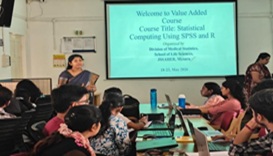
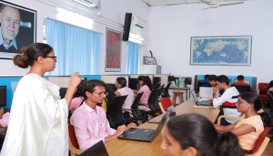
The Division has a dedicated Medical Statistics Laboratory equipped with computing facilities to support hands-on training in statistical analysis, data management, research methodology, epidemiological studies, clinical data analysis, and healthcare analytics. - Statistical Software and Computational Tools
The Division provides access and training in a wide range of statistical and data analytical software tools used in academics, research, healthcare, and industries. Students receive practical experience in statistical programming, data visualization, predictive modelling, machine learning, and artificial intelligence applications using software platforms such as R, Python, SPSS version 30, JAMOVI, JASP, WEKA, Tableau, MATLAB, JMP and other open- source statistical computing tools.