TIFAC CORE in Herbal Drugs
The Technology Information, Forecasting and Assessment Council (TIFAC) is an autonomous organization established in 1988 under the Department of Science & Technology (DST), Government of India. Its mandate is to anticipate technological trends, assess emerging technology trajectories, and promote innovation through coordinated actions in areas of national importance. Under the broad umbrella of Technology Vision 2020, TIFAC launched an ambitious mission called REACH - Relevance and Excellence in Achieving New Heights in Educational Institutions. Mission REACH was formally inaugurated by Dr. A.P.J. Abdul Kalam, then Principal Scientific Adviser to the Government of India, on October 4, 2000, in New Delhi.
The Apex Committee appointed by TIFAC selected JSS College of Pharmacy, Ooty, for the establishment of a Centre of Relevance and Excellence (CORE) in Herbal Drugs under the TIFAC–MISSION REACH programme. The TIFAC CORE in Herbal Drugs has been functioning since January 2001, with the mandate to promote research, innovation, and capacity building in herbal drugs and natural products, in particular support of Indian industries engaged in traditional and herbal medicine.
VISION
- TIFAC CORE in Herbal Drugs will meet the specialized demands of the human resource requirements of the pharmaceutical industries engaged in the development of herbal drugs.
- The centre will also endeavor to document the herbal medicinal practices and the medicinal plants of the region to protect the heritage of our country from piracy.
MISSION
TIFAC has been carrying out the mission under the Technology Vision 2020 projects. One of these missions, code names REACH (Relevance and Excellence in Achieving new heights in educational institutions), aims at upgrading select science college, in the country as “Centres of Relevance and Excellence (CORE)” to broaden the level of education and meet the scientific technological manpower requirements of India in advanced areas promising to show-up on the horizon in the years to come.
Key Objectives
- To undertake research programmes supporting industries involved in herbal and traditional medicinal products.
- To function as a skill-development centre for all stakeholders in natural products.
- To serve as a training and knowledge centre empowering tribal youth to sustain indigenous folk medicine.
- To provide consultancy to natural product industries and regulatory bodies.
- To design and offer industry-relevant academic programmes.
- To emerge as a global leader in natural product research and development.
Target Milestones
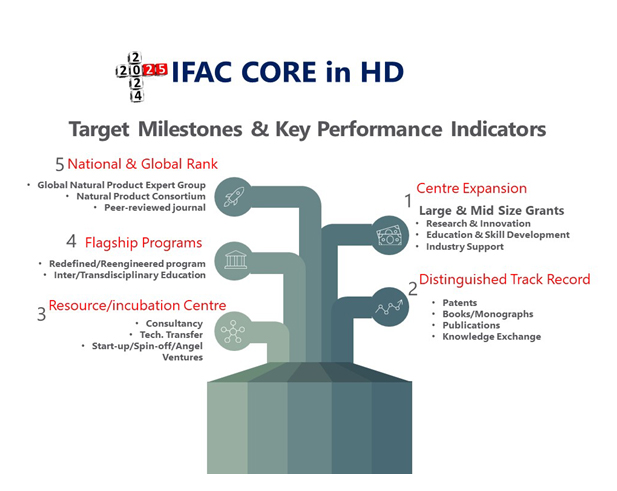
For the period 2026–2031, the TIFAC centre, will focus on achieving strategic growth and measurable outcomes aligned with the vision of the Technology Information, Forecasting and Assessment Council by strengthening research excellence, innovation, and industry engagement. The key performance indicators will include expansion through large and mid-sized research grants to enhance infrastructure, innovation capacity, and skill development; building a distinguished track record through increased patents, high-impact publications, books, and global knowledge exchange; and developing a robust resource and incubation ecosystem through consultancy, technology transfer, and promotion of start-ups and entrepreneurial ventures. The Centre will further emphasize flagship interdisciplinary academic programmes aligned with industry needs to improve employability and advanced research training, while simultaneously striving for higher national and global rankings through impactful research outputs and strategic collaborations. Collectively, these KPIs will reinforce the Centre’s leadership in product development, technology transfer, sustainable healthcare solutions, and societal impact, establishing it as a premier hub for herbal drug research and innovation.