JSS Medical College
Smart - 10.0 Workshop
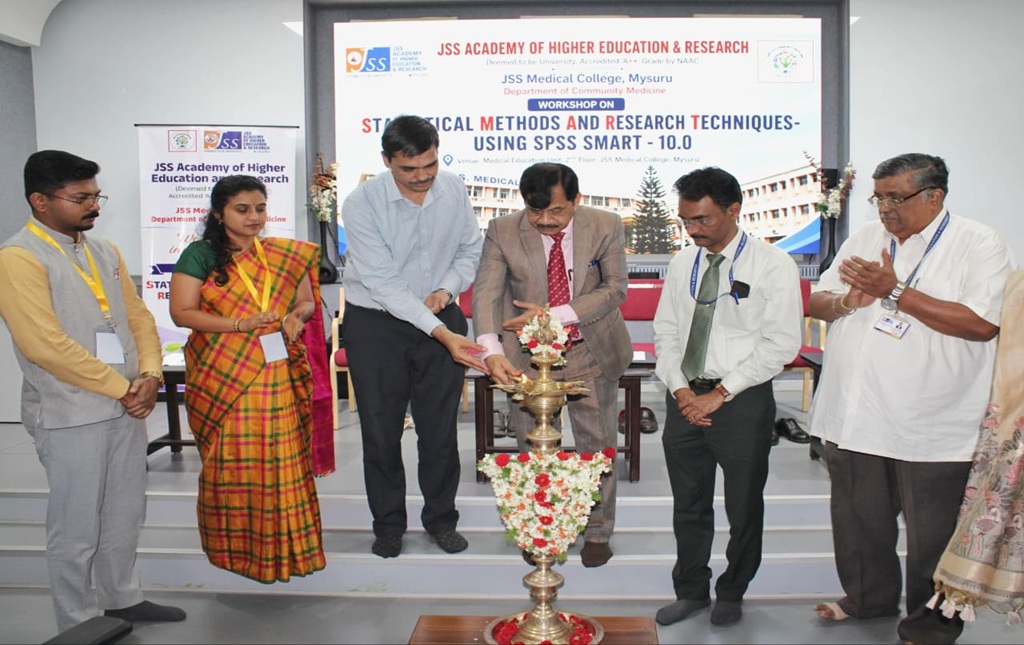
The Department of Community Medicine, JSS Medical College, Mysuru, successfully organized SMART–10.0, a two-day workshop on Statistical Methods and Research Techniques Using SPSS, on 24th and 25th June 2026 at the Medical Education Unit, JSS Medical College, Mysuru. The workshop was designed to strengthen participants' understanding of research methodology, biostatistics, data analysis, and scientific writing. It aimed to equip undergraduate and postgraduate students, faculty members, researchers, and healthcare professionals with the knowledge and practical skills required to independently manage and analyse research data using SPSS. The programme commenced on 24th June 2026 with an inaugural ceremony. The event began with an invocation, followed by the welcome address delivered by Dr. Madhu B, Professor and Head, Department of Community Medicine, and Organizing Chairperson. The workshop was formally inaugurated with the ceremonial lighting of the lamp in the presence of the Chief Guest, Dr. H. Basavanagowdappa, Vice Chancellor, JSS Academy of Higher Education & Research,. Dr. Manthappa, Vice Principal (Clinical), Dr. Vikram Patil, Vice Principal and Mr. Satishchandra S. R, Administrative Officer, JSS Medical College, Mysuru also addressed the gathering, emphasizing the importance of research competency, statistical literacy, and evidence-based healthcare. The inaugural session concluded with a vote of thanks proposed by Mr. Arun Gopi, Organizing Secretary. The academic sessions on Day 1 commenced with an introductory session by Dr. Madhu B, providing an overview of the workshop objectives and expected learning outcomes. This was followed by an integrated practical session on 'Formulating Research Questions, Objectives, and Study Designs', facilitated by Dr. Kavya G. Upadhya and Dr. Mythily M. R. The session focused on transforming broad research ideas into well-defined, feasible, and scientifically relevant research questions, along with the selection of appropriate epidemiological study designs. The subsequent session on 'Sampling Techniques Using Applied Scenarios' was conducted by Dr. Rashmi S., who introduced participants to probability and non-probability sampling methods and highlighted their applications in both community-based and clinical research. Dr. Nayanabai Shabadi delivered a session on Descriptive Statistics, covering measures of central tendency, measures of dispersion, proportions, and methods of data presentation. The session emphasized selecting appropriate descriptive statistical measures based on the nature and distribution of data. The hands-on component commenced with SPSS Module 1, facilitated by Mr. Arun Gopi, focusing on data entry, variable coding, data management, and data cleaning. Participants were guided through dataset creation, variable definition, value labelling, and identification of data entry errors and missing values. This was followed by SPSS Module 2: Descriptive Statistics in SPSS, during which participants generated frequency tables, descriptive summaries, and graphical outputs using sample datasets. The day concluded with a supervised practical session, enabling participants to apply the concepts learned through guided exercises using real-world datasets. Overall, the first day of SMART–10.0 successfully integrated theoretical concepts with practical application, providing participants with a strong foundation in research methodology, data management, descriptive statistics, and SPSS-based data analysis. The academic sessions on 25th June 2026 commenced with a session on Hypothesis Testing, delivered by Dr. Smitha M C., who provided an applied understanding of hypothesis formulation, including null and alternative hypotheses, statistical significance, and the concepts of Type I and Type II errors. The subsequent session on Sample Size Estimation was conducted by Dr. Amoghashree, who explained the principles of determining appropriate sample sizes across different clinical and epidemiological study designs using practical examples. Dr. Sunitha Singh conducted an interactive session on Inferential Statistics, covering the fundamental concepts of statistical inference and guiding participants on the appropriate selection and interpretation of parametric and non-parametric statistical tests, with particular emphasis on Student's t-test and the Chi-square test. The practical component continued with SPSS Module 3, facilitated by Mr. Arun Gopi, during which participants performed inferential statistical analyses using SPSS and interpreted the outputs under guided supervision. The final academic session on Correlation and Regression was delivered by Dr. Madhu B., who discussed the principles of correlation analysis, regression models, and their applications in health research involving continuous variables. The two-day training programme concluded with a valedictory ceremony presided over by the Chief Guest, Dr. D. Narayanappa, Principal, JSS Medical College. In his address, he highlighted the pivotal role of sound research methodology and statistical analysis in promoting evidence-based healthcare and quality research. The ceremony concluded with the distribution of participation certificates by the Chief Guest and other dignitaries, recognizing the participants' successful completion of the workshop and their active engagement throughout the programme. SMART–10.0 witnessed overwhelming participation of more than 56 registrations from undergraduate and postgraduate students, faculty members, researchers, and healthcare professionals representing Endocrinology, General Medicine, Clinical Immunology and Rheumatology, Clinical Psychology, Cardiology, Community Medicine, Psychiatry, Microbiology, Clinical Research, Biochemistry, Occupational Therapy, Hospital Administration, Medical Genetics, Physiology, and Public Health, and biomedical sciences. The workshop was well received for its balanced integration of conceptual lectures, interactive discussions, and hands-on SPSS training, enabling participants to strengthen their competencies in research methodology, statistical analysis, and scientific data interpretation. The programme successfully fulfilled its objective of promoting research excellence and enhancing statistical skills among healthcare professionals and researchers.
.jpg)
.jpg)
.png)
.png)
.png)
.png)
.png)
.png)
.png)
.png)
.png)