


Overview
The Integrated M.Sc. / M.Sc. Honors in Computer Science (Intelligent Health Systems) is offered by the Global Institute for Future Technologies (JSS GIFT), an academic initiative of JSS Academy of Higher Education & Research (JSS AHER). It is designed as a global health-technology talent pathway that prepares students to work at the intersection of health sciences, medicine, hospital systems, public health, biomedical technologies, clinical data, artificial intelligence, digital health platforms, medical imaging, wearable intelligence, health informatics, generative AI, clinical decision support, medical devices, genomics, regulatory science and healthcare product innovation.
The program is not merely an “AI-in-healthcare” degree. It is designed to create healthcare intelligence professionals who can understand real healthcare problems, work with clinical and biomedical data, build intelligent systems, validate AI models, design deployable digital health products, respect patient safety, and contribute to global health-tech companies and research ecosystems — following JSS GIFT's Learn – Build – Experience – Discover – Create – Lead philosophy, so that the graduate can think with science, reason with health data, understand healthcare systems, build with technology, validate with evidence, deploy with responsibility, act with patient safety, and lead in global health technology.
The program runs across a Pre-Semester and Semesters I to X, requiring 196 Qualifying Credits plus 10 mandatory Binary Graded Credits for the award of the M.Sc. degree. Students may additionally take up to 28 Add-on Credits toward an Add-on Graduate Diploma alongside the core program.
In keeping with the National Education Policy (NEP) 2020, the program follows the same multiple-entry, multiple-exit structure used across JSS GIFT's Integrated M.Sc. programs, illustrated below:
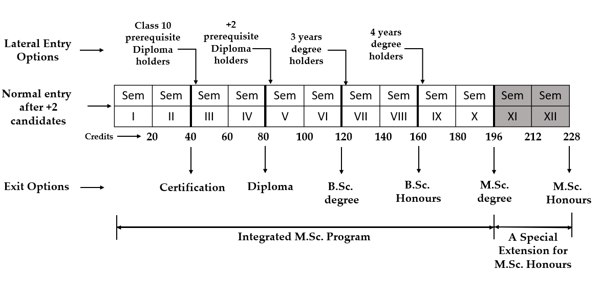
As the figure shows, a student entering after +2/PUC (Normal Entry) progresses through Semesters I–X, while candidates with a Diploma or an existing degree may join laterally at Semester III, V, VII, IX or XI depending on their qualification. For this stream, a student who does not continue further can exit with a formal, stream-named award proportional to the credits completed: a Certificate in Intelligent Health Systems after Year 1 (40 credits), a Diploma in Intelligent Health Systems after Year 2 (80 credits), a B.Sc. in Intelligent Health Systems after Year 3 (120 + 10 Binary credits), a B.Sc. Honors in Intelligent Health Systems after Year 4 (160 + 10 Binary credits), or the Integrated M.Sc. in Intelligent Health Systems after Year 5 (196 + 10 Binary credits). Students who wish to go further may undertake a special two-semester Global Health-Tech Research and Product Fellowship extension (Semester XI–XII, an additional 32 credits) to earn the Integrated M.Sc. Honors in Intelligent Health Systems (228 + 10 Binary credits).
Within this structure, the curriculum follows a deliberate capability progression — Readiness → Health Systems Foundations → Programming → Health Data → EHR and Interoperability → Digital Health Applications → Machine Learning → Wearables and Hospital Intelligence → Deep Learning → Clinical Decision Support → Regulation and Responsible AI → Medical Imaging → Clinical NLP → Public Health Intelligence → Generative AI → MLOps and Cybersecurity → Product Engineering → Clinical Validation → Specialization → Capstone → Global Health-Tech Portfolio → M.Sc. Honors Research/Product/Residency. From Semester VII/VIII onward, continuing into Semesters IX and X, students choose one of eight Global Health-Tech Specialization Tracks (see CAREER PROSPECTS).
Learning is reinforced through Progressive Portfolio Gates at the end of each year — from a Health-Tech Foundation Portfolio in Year 1 to a Global Health-Tech Capstone Portfolio (dissertation, working system, validation and deployment demo, regulatory-style documentation) in Year 5 — alongside a staged internship and immersion model that moves students from hospital and public-health observation, to digital workflow observation, a skill-based mini-internship, hospital/health-tech company immersion, and finally an industry, hospital or research capstone engagement. Assessment combines the standard JSS GIFT weightage of 70% Formative and 30% Summative Assessment with company-aligned readiness dimensions such as clinical relevance, validation evidence, ethical and regulatory reflection, and deployment maturity.
Academically, the program operates under the JSS GIFT Regulations, with curriculum and course content recommended by the Board of Studies and approved by the Academic Council — the highest statutory academic body of JSS AHER, chaired by the Vice Chancellor — keeping the program aligned with AICTE/UGC-linked regulatory expectations.