


img JSS GIFT JSS GIFT
shape

Integrated M.Sc. / M.Sc. Honors in Computer Science


  Apply Now    Downloads

Overview

Integrated M.Sc. / M.Sc. Honors in Computer Science (AI / Data Science / Intelligent Systems) is offered by the JSS Global Institute for Future Technologies (JSS GIFT), an academic initiative of JSS Academy of Higher Education & Research (JSS AHER). JSS GIFT was set up to bring advanced technologies — Artificial Intelligence, Data Science and Intelligent Systems — into both dedicated technology education and traditionally non-technology domains such as medicine, pharmacy and life sciences, and this program is one of the two founding programs launched under JSS GIFT.

Will outline the program philosophy, the L-T-P-SL course design framework (Lecture, Transaction, Practice, Self-Learning), the progressive project architecture (Mini Projects I-III, Major Project, Capstone), and the Formative-heavy assessment model (70% Continuous Formative / 30% Summative)

The program is designed as a five-year, future-technology academic pathway rather than a narrow, tool-based AI course. It develops learners progressively into scientific thinkers, AI-era professionals, data-driven problem solvers, intelligent-systems builders, ethical technology practitioners, researchers and interdisciplinary collaborators — following JSS GIFT's Learn – Build – Experience – Discover – Create – Lead philosophy: building conceptual foundations, developing real systems and prototypes, engaging with industry and society, participating in research, creating deployable innovations, and leading with communication, ethics and a future-technology perspective.

The program runs across a Pre-Semester and Semesters I to X, requiring 196 Qualifying Credits plus 10 mandatory Binary Graded Credits (covering holistic-development areas such as ethics and life skills) for the award of the M.Sc. degree. Students may additionally take up to 28 Add-on Credits toward an Add-on Graduate Diploma alongside the core program.

In keeping with the National Education Policy (NEP) 2020, the program follows a multiple-entry, multiple-exit structure, illustrated below:
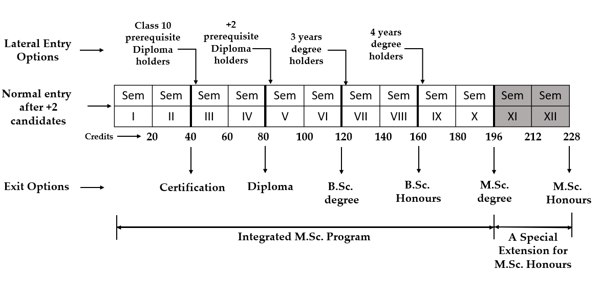
As the figure shows, a student entering after +2/PUC (Normal Entry) progresses through Semesters I–X, while candidates with a Diploma or an existing degree may join laterally at Semester III, V, VII, IX or XI depending on their qualification. At any stage, a student who does not continue further can exit with a formal award proportional to the credits completed — a Certification after Semester II (40 credits), a Diploma after Semester IV (80 credits), a B.Sc. degree after Semester VI (120 credits), a B.Sc.-Honors degree after Semester VIII (160 credits), or the M.Sc. degree after Semester X (196 credits). Students who wish to go further may undertake a special two-semester extension (Semester XI–XII) to earn the M.Sc.-Honors degree (228 credits).

Within this structure, the AI, Data Science and Intelligent Systems curriculum follows a deliberate capability progression — Readiness → Foundations → Computing → Data → AI → Machine Learning → Deep Learning → Intelligent Systems → Generative AI → Decision Intelligence → Domain Intelligence → Research → Product Building → Capstone. In the fifth year (Semester IX), students choose a specialization pathway from a basket that includes AI Engineering; Data Science and Decision Intelligence; Generative AI and AI Agents; Intelligent Applications and Human-AI Systems; Autonomous and Cyber-Physical Intelligence; AI for Healthcare, Life Sciences and Society; and Intelligent Theoretical Computing.

Learning is reinforced through a progressive project architecture — a Mini Project in each of the first three years, a Major Project in Year 4, and a Capstone (research, industry or product-oriented) in Year 5 — alongside a staged internship and immersion model that moves students from early domain exposure to skill-based mini-internships, domain immersion, and finally a research/industry/product engagement. Assessment is continuous and technology-integrated, combining Group and Individual Formative Assessment with end-semester Summative Assessment.

Eligibility

Entry Point Eligible Qualification
Normal Entry — Semester I PUC / +2 / 12th Standard with Science and Mathematics. Also open to JEE / CET / IISER examinees.
Diploma Holder (Class X prerequisite) — Semester III Diploma in Computer Science and related/allied subjects.
Diploma Holder (+2 prerequisite) — Semester V Diploma in Computer Science and related/allied subjects.
3-Year Degree Holder — Semester VII B.Sc. in Computer Science and related/allied subjects.
4-Year Degree Holder — Semester IX B.S. / B.Sc. (Honors) / B.Tech. / B.E. in Computer Science, Information Technology or related/allied subjects.
5-Year / PG Degree Holder — Semester XI (M.Sc.-Honors pathway) M.Sc. / MCA in Computer Science, Information Technology or related/allied subjects.

Lateral Entry Provisions

Candidates seeking lateral admission are screened by the Equivalence & Credit Transfer Committee, which determines the credits that can be transferred and identifies any bridge or make-up courses the candidate must additionally complete, either before or during the program

A candidate entering with a B.Sc. degree and pursuing only the M.Sc. (post-B.Sc.) pathway is required to complete 76 credits to qualify for the award of the M.Sc. degree.

A candidate entering with a B.Sc. Honors degree (4 years degree such as B.Tech/B.E/B.S) can pursue for one year M.Sc. or 2 years M.Sc. Honors (M.Tech/M.E/M.S)

A working professional with a 4 years degree can opt for Research Pathway to acquire M.Sc. Honors (M.Tech/M.E/M.S)

Career Prospect

Graduates of the Integrated M.Sc. in Artificial Intelligence, Data Science and Intelligent Systems are positioned as AI-era scientific professionals — able to think with science, reason with data, build intelligent systems, research with discipline, act with ethics, and lead in the AI era. The curriculum's Program Outcomes span scientific and mathematical reasoning, computational and programming capability, data science, AI/ML and intelligent-systems design, generative AI, domain-aware application, research capability, responsible technology practice, and product/innovation capability — preparing graduates for a wide range of roles, including:

  • Engineering & Development: AI Engineer, Machine Learning Engineer, Data Engineer, Applied AI Developer, Intelligent Systems Developer, Generative AI Application Developer, MLOps Associate, Data Platform Associate, AI Product Builder.
  • Analytics & Decision Intelligence: Data Scientist, Decision Intelligence Analyst, Business Intelligence Analyst, Computer Vision Associate, NLP Engineer.
  • Applied AI & Consulting: AI Product Analyst, Human-AI Interaction Analyst, Automation Analyst, AI Solutions Consultant.
  • Research & Innovation: AI Research Assistant, Research Fellow / Ph.D. Aspirant, Startup Founder / AI Innovation Associate.
  • The Year 5 specialization baskets extend these prospects into specific sectors: AI Engineering and Autonomous and Cyber-Physical Intelligence (robotics, edge AI, sensor and control systems) prepare students for product- and infrastructure-heavy roles; Data Science and Decision Intelligence and Generative AI and AI Agents lead toward analytics, LLM engineering and applied GenAI roles; Intelligent Applications and Human-AI Systems supports careers in conversational and recommender systems; and AI for Healthcare, Life Sciences and Society opens pathways into health-tech, biomedical AI and public-systems intelligence.
  • Career readiness is built progressively rather than left to the final year: a Mini Project in each of the first three years, a Major Project in Year 4, and a Capstone in Year 5 are paired with a staged internship and immersion model — moving from early domain exposure to skill-based mini-internships, domain immersion, and a final research/industry/product engagement — so graduates leave with a working portfolio of prototypes and projects. Students who take the optional M.Sc.-Honors extension additionally complete a research thesis and a publication/patent/product studio, positioning them for doctoral study or research-intensive industry roles.
  • Because the program follows NEP 2020's multiple-exit framework, each earlier exit stage is also mapped to defined, employable capability: a Certificate (Year 1) or Diploma (Year 2) exit reflects foundational programming, data-literacy and computational problem-solving skills, while a B.Sc. (Year 3) or B.Sc.-Honors (Year 4) exit reflects working capability in machine learning, deep learning, intelligent-application development and applied AI product/research prototyping the extensive career pathways listed in the curriculum, detailing roles such as AI Engineer, Data Scientist, ML Engineer, Decision Intelligence Analyst, NLP Engineer, MLOps Associate, and GenAI Developer

Fee

The JSS GIFT Regulations do not publish a fixed fee schedule — tuition and semester fees are prescribed and revised by the Institute from time to time and communicated through official fee notifications at the time of admission and before each semester. The Regulations do, however, define when and how fees become payable across the program:

  • Before the start of every semester, a candidate must pay the stipulated tuition/semester fee and register for the courses intended for that Odd/Even semester (Section 5.4.1).
  • The regular semester/annual fee is payable for the first five years of the program regardless of the number of credits actually registered for in a given semester — including where a semester is dropped (Section 5.5.1).
  • If a candidate needs a spill-over semester beyond five years (up to the 10-year maximum), a semester fee proportional to the credits registered for applies during that extended period (Section 5.5.2).
  • Registering for a summer semester attracts an additional fee proportional to the credits taken (Section 5.5.3).
  • A nominal fee applies to online re-assessment appeals on summative assessment scores, submitted within 48 hours of result notification (Section 9.5).
  • Supplementary examinations carry a separately notified fee, communicated by the Examination Section along with registration procedures and timetables (Section 12.1).
  • A candidate exercising the voluntary Drop/Sabbatical Semester option pays the regular semester fee if this occurs within the first 10 semesters, or a nominal semester maintenance fee if it occurs during the spill-over period (Section 16.3).

Course Coordinator

The JSS GIFT Regulations define the Course Coordinator as part of the academic team responsible for a program's day-to-day administration, working alongside the Head of Department (HoD) and the concerned teacher(s). For example, in setting the relative-grading thresholds used to map Formative and Summative Assessment scores, the Regulations specifically require the HoD, the Course Coordinator and the teacher concerned to jointly decide the mapping range applied to student scores (Section 10, Step 2).

This role sits within JSS GIFT's broader academic governance structure: each program belongs to a Department headed by an HoD, within a School; course content and curriculum are recommended by the Board of Studies and approved by the Academic Council (chaired by the Vice Chancellor); and matters not explicitly covered by the Regulations are referred to the Head, JSS GIFT, for interpretation, with the decision reported to the Academic Council (Section 16.5). Functionally, the Course Coordinator acts as a student's first point of academic contact for matters relating to a specific course or program — assessment queries, grade mapping, and coordination between faculty and students.

The name, designation and contact details of the current Course Coordinator for the Integrated M.Sc. in Intelligent Health Systems are not specified in the JSS GIFT Regulations or the program curriculum. This information should be added by the JSS GIFT department when publishing this page, and kept updated as coordinators are assigned each academic year.

Syllabus

Semester-wise Curriculum Structure

Semester I

Foundations of Science, Computing and AI

Qualifying Credits: 12

Course Code Course Title L:T:P Credits Prerequisite / Readiness Requirement
GFT-AI1101 Scientific Thinking and Systems Orientation 2:1:1 4 Completion / concurrent completion of Pre-Semester academic orientation
GFT-AI1102 Python Programming for Problem Solving 1:1:2 4 GFT-PS1102 and GFT-PS1104, or equivalent programming readiness
GFT-AI1103 Foundations of Data Literacy and Digital Systems 2:1:1 4 GFT-PS1103, or equivalent digital academic readiness
Total 12

Semester I Outcome

Students should be able to reason scientifically, understand systems, represent data digitally, write simple programs, use Python for structured problem solving and begin technology-integrated academic practice.

Note on GFT-AI1101 and GFT-AI1102

These courses shall be delivered as applied foundation courses for AI and Data Science. They shall not assume advanced engineering mathematics. Students from state-board, biology, commerce-mathematics or non-computer-science backgrounds shall be supported through diagnostic assessment, bridge worksheets, guided tutorials, mathematics clinics and computational demonstrations.

Semester II

Mathematics, Programming and Data Foundations Qualifying Credits: 20
Course Code Course Title L:T:P Credits Prerequisite / Readiness Requirement
GFT-AI1201 Linear Algebra and Matrix Methods for AI 2:1:1 4 GFT-PS1101; Mathematics Clinic support for students requiring bridge help
GFT-AI1202 Probability and Statistics for Data Science 2:1:1 4 GFT-PS1101; Mathematics Clinic support for students requiring bridge help
GFT-AI1203 Programming Structures and Algorithmic Thinking 1:1:2 4 GFT-AI1102
GFT-AI1204 Data Handling, Visualization and Exploratory Analysis 1:1:2 4 GFT-AI1103 and basic Python readiness
GFT-AI1205 Mini Project I: Data and Problem Discovery 0:1:3 4 Concurrent completion of GFT-AI1201, GFT-AI1202, GFT-AI1203 and GFT-AI1204
Total 20

Semester III

Core Computing and Data Systems Qualifying Credits: 20
Course Code Course Title L:T:P Credits Prerequisite / Readiness Requirement
GFT-AI2101 Discrete Mathematics and Logic for Intelligent Systems 2:1:1 4 GFT-AI1201 and GFT-AI1203
GFT-AI2102 Data Structures and Algorithms 1:1:2 4 GFT-AI1203
GFT-AI2103 Database Systems and Data Modelling 1:1:2 4 GFT-AI1204
GFT-AI2104 Object-Oriented Design and Software Construction 1:1:2 4 GFT-AI1102 and GFT-AI1203
GFT-AI2105 Technology-Integrated Practice Lab I 0:1:3 4 Concurrent completion of GFT-AI2102, GFT-AI2103 and GFT-AI2104
Total 20

Semester IV

AI Foundations and Applied Data Analytics Qualifying Credits: 20
Course Code Course Title L:T:P Credits Prerequisite / Readiness Requirement
GFT-AI2201 Foundations of Artificial Intelligence 2:1:1 4 GFT-AI2101 and GFT-AI2102
GFT-AI2202 Statistical Modelling and Inferential Analytics 2:1:1 4 GFT-AI1202
GFT-AI2203 Data Engineering Foundations 1:1:2 4 GFT-AI2103 and GFT-AI1204
GFT-AI2204 Web, APIs and Intelligent Application Development 1:1:2 4 GFT-AI2104
GFT-AI2205 Mini Project II: Data Product Prototype 0:1:3 4 Concurrent completion of GFT-AI2201 to GFT-AI2204
Total 20

Semester V

Machine Learning and Intelligent Applications Qualifying Credits: 20
Course Code Course Title L:T:P Credits Prerequisite / Readiness Requirement
GFT-AI3101 Machine Learning Foundations 2:1:1 4 GFT-AI1201, GFT-AI1202 and GFT-AI1204
GFT-AI3102 Optimization Methods for AI and Data Science 2:1:1 4 GFT-AI1201 and GFT-AI1202
GFT-AI3103 Operating Systems, Cloud and Computing Infrastructure 2:1:1 4 GFT-AI2102 and GFT-AI2104
GFT-AI3104 Human-Centred Design for Intelligent Applications 1:1:2 4 GFT-AI1101 and GFT-AI2204
GFT-AI3105 Applied ML Lab I 0:1:3 4 Concurrent completion of GFT-AI3101
Total 20

Semester VI

Deep Learning, Intelligent Systems and Research Foundations Qualifying Credits: 20
Course Code Course Title L:T:P Credits Prerequisite / Readiness Requirement
GFT-AI3201 Deep Learning and Neural Networks 2:1:1 4 GFT-AI3101 and GFT-AI3102
GFT-AI3202 Intelligent Systems: Sensing, Reasoning and Adaptation 2:1:1 4 GFT-AI2201 and GFT-AI3101
GFT-AI3203 Research Methodology and Scientific Writing 2:1:1 4 Completion of Year 2 courses or equivalent academic readiness
GFT-AI3204 Responsible AI, Data Ethics and Society 2:1:1 4 GFT-AI1101 and GFT-AI2201
GFT-AI3205 Mini Project III: Intelligent System Prototype 0:1:3 4 Concurrent completion of GFT-AI3201, GFT-AI3202 and GFT-AI3204
Total 20

Year 3 Exit

On successful completion of 120 Qualifying Credits + 10 Binary Graded Credits, the student may exit with: B.Sc. in Artificial Intelligence, Data Science and Intelligent Systems A student completing an additional 12 Add-on Credits, where applicable, may be eligible for: B.Sc. with Add-on Certification

Semester VII

Advanced AI, Systems and Domain Intelligence Qualifying Credits: 20
Course Code Course Title L:T:P Credits Prerequisite / Readiness Requirement
GFT-AI4101 Advanced Machine Learning and Model Engineering 2:1:1 4 GFT-AI3101 and GFT-AI3105
GFT-AI4102 Natural Language Processing and Text Intelligence 2:1:1 4 GFT-AI3101 and Python programming capability
GFT-AI4103 Computer Vision and Visual Intelligence 2:1:1 4 GFT-AI3201 and Python programming capability
GFT-AI4104 Domain Intelligence Elective I 2:1:1 4 Completion of Year 3 courses or approval of Program Committee
GFT-AI4105 Industry / Domain Immersion Project I 0:1:3 4 GFT-AI3203 and approval of project mentor
Total 20

Domain Intelligence Elective I Options

Students may choose from:
  • AI for Healthcare and Life Sciences
  • AI for Business and Financial Systems
  • AI for Education and Learning Systems
  • AI for Public Systems and Governance
  • AI for Industrial and Manufacturing Systems
  • AI for Environment and Sustainability
  • Intelligence Theoretical Computing

Semester VIII

Generative AI, Decision Intelligence and Product Systems Qualifying Credits: 20
Course Code Course Title L:T:P Credits Prerequisite / Readiness Requirement
GFT-AI4201 Generative AI, Large Language Models and RAG Systems 2:1:1 4 GFT-AI4102 and GFT-AI3201
GFT-AI4202 Decision Intelligence and Causal Reasoning 2:1:1 4 GFT-AI2202 and GFT-AI3101
GFT-AI4203 MLOps, AI Deployment and Model Governance 1:1:2 4 GFT-AI3103 and GFT-AI3101
GFT-AI4204 AI Product Engineering and Innovation Studio 1:1:2 4 GFT-AI3104 and GFT-AI2204
GFT-AI4205 Major Project I: AI Product / Research Prototype 0:1:3 4 GFT-AI3203 and completion of at least two advanced AI courses
Total 20

Year 4 Exit

On successful completion of 160 Qualifying Credits + 10 Binary Graded Credits, the student may exit with: B.Sc. Honors in Artificial Intelligence, Data Science and Intelligent Systems A student completing an additional 20 Add-on Credits may be eligible for one of the following:
  • Add-on Diploma
  • Add-on Minor Diploma
  • Add-on Major Diploma
  • Add-on Research Major
  • Add-on Certification, where credits are less than the prescribed diploma threshold

Semester IX

Specialization, Research and Advanced Intelligent Systems Qualifying Credits: 20
Course Code Course Title L:T:P Credits Prerequisite / Readiness Requirement
GFT-AI5101 Specialization Elective I 2:1:1 4 Completion of relevant specialization foundation
GFT-AI5102 Specialization Elective II 2:1:1 4 Completion of relevant specialization foundation
GFT-AI5103 Advanced Research Methods for AI and Data Science 2:1:1 4 GFT-AI3203
GFT-AI5104 AI Systems Architecture and Scalable Intelligent Platforms 1:1:2 4 GFT-AI4203 and GFT-AI3103
GFT-AI5105 Capstone Phase I: Research / Industry / Product Definition 0:1:3 4 GFT-AI4205 and approved capstone proposal area
Total 20

Specialization Basket

Students may choose one specialization pathway.

Track A: AI Engineering

  • Advanced Model Engineering
  • Scalable AI Systems
  • AI Infrastructure and Pipelines
  • Applied AI Architecture

Track B: Data Science and Decision Intelligence

  • Advanced Analytics
  • Causal AI
  • Business Intelligence and Decision Systems
  • Data Storytelling and Evidence Design

Track C: Generative AI and AI Agents

  • LLM Engineering
  • Retrieval-Augmented Generation
  • AI Agents and Workflow Automation
  • Evaluation and Safety of Generative AI

Track D: Intelligent Applications and Human-AI Systems

  • Human-AI Interaction
  • Conversational Systems
  • Personalization and Recommender Systems
  • AI for Assistive and Inclusive Technologies

Track E: Autonomous and Cyber-Physical Intelligence

  • Robotics Intelligence
  • Sensor Data Intelligence
  • Edge AI
  • Intelligent Control Systems

Track F: AI for Healthcare, Life Sciences and Society

  • Health Data Science
  • Biomedical AI Foundations
  • Public Systems Intelligence
  • AI for Social Good
Track G: Intelligence Theoretical Computing Students may choose courses from the following basket
  • Graph Theoretical Thinking for Intelligent Design
  • Algorithmic Thinking for Learning and Intelligence
  • Data Structure Models for Intelligent Systems
  • Computational Infrastructure for Scalable Intelligence
  • Representation Thinking for AI Models
  • Complexity Thinking for Intelligent Problem Solving
  • Computational Models of Reasoning and Decision Intelligence
  • Network Science and Emergent Intelligence
  • Formal Models for Safe and Explainable AI
  • Computational Design of AI Agents and Intelligent Workflows

Semester X

Capstone, Professional Readiness and Future Leadership Qualifying Credits: 16
Course Code Course Title L:T:P Credits Prerequisite / Readiness Requirement
GFT-AI5201 Specialization Elective III 2:1:1 4 Completion of Specialization Elective I / II or equivalent
GFT-AI5202 AI Governance, Policy, Safety and Future Technology Leadership 2:1:1 4 GFT-AI3204 and GFT-AI4203
GFT-AI5203 Capstone Phase II: Implementation, Evaluation and Dissertation 0:2:6 8 GFT-AI5105 and approved capstone proposal
Total 16